
 By Upload Article Team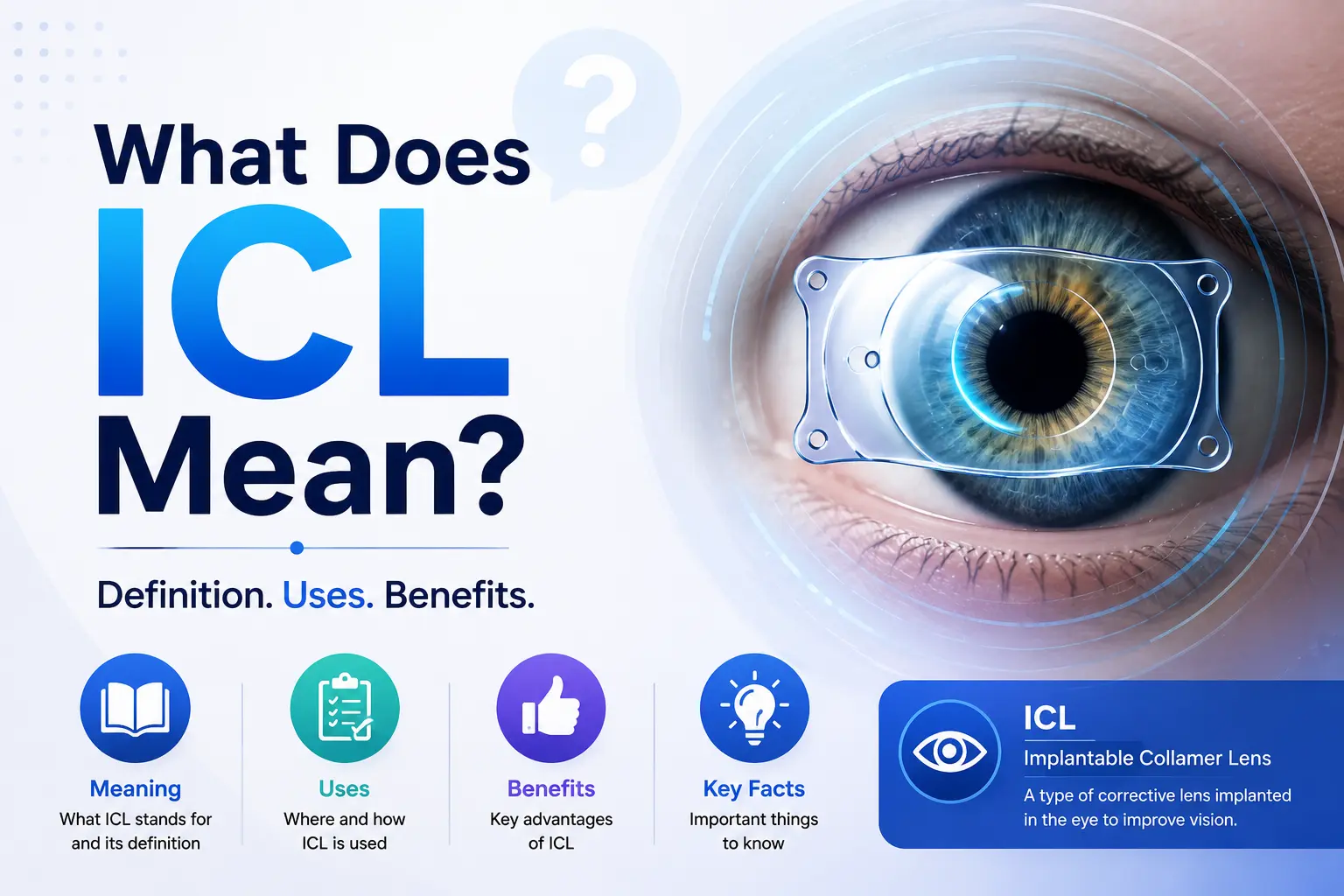
If you have been researching ways to see better without glasses or contacts, you may have come across the letters “ICL” and wondered exactly what they mean.
So, what does ICL mean? ICL stands for Implantable Collamer Lens. It is a small, soft lens placed inside the eye to help correct blurry vision, without removing any part of your natural eye.
This guide is for anyone curious about ICL, whether you are just starting your research or getting ready to talk with an eye doctor. By the end, you will understand what ICL means, how it works, who it may help, and what questions to ask before considering it.
Important note: This article is for general information only. It is not medical advice. Always talk to a licensed eye doctor, such as an ophthalmologist, before making any decisions about eye surgery.
ICL stands for Implantable Collamer Lens. It is a small lens placed inside the eye to correct vision problems like nearsightedness. Unlike some other vision correction options, it does not reshape the eye’s surface, and in some cases, it can be removed later by an eye doctor.
Table of Contents
What Does ICL Mean?
ICL stands for Implantable Collamer Lens.
Let’s break that down into simple parts:
- Implantable means it is placed inside the body.
- Collamer is the special material the lens is made from. It is a soft, flexible material designed to work well inside the eye.
- Lens is the part that helps focus light so you can see clearly.
In simple words, an ICL is a tiny artificial lens that a doctor places inside your eye to help fix blurry vision.
This is different from glasses or contacts, which sit outside the eye. It is also different from laser eye surgery, which reshapes the surface of the eye instead of adding a lens.
How Does an ICL Work?
To understand how ICL works, it helps to know how normal vision works first.
Your eye already has a natural lens. Light passes through your eye, and the lens helps focus that light onto the back of your eye, called the retina. If the light does not focus correctly, your vision becomes blurry.
An ICL does not replace your natural lens. Instead, it is placed carefully in front of it, working almost like a permanent contact lens living inside your eye.
This extra lens helps bend light correctly, so images appear clearer without needing glasses or contacts every day.
Read More: Pixelspinx Com: The Honest 2026 Review You Actually Need
Who Might ICL Be a Good Option For?
ICL is often considered by people who:
- Have nearsightedness, meaning distant objects look blurry
- Want an alternative to glasses or daily contact lenses
- Are not ideal candidates for certain laser eye surgeries, sometimes due to thin corneas
- Want a vision correction option that may be reversible in certain cases
However, ICL is not automatically the right choice for everyone. An eye doctor must examine your eyes closely before recommending it. Factors like eye health, prescription strength, and overall medical history all play a role in this decision.
ICL vs Other Vision Correction Options
It helps to compare ICL with other common vision correction choices.
| Option | How It Works | Reversible? |
| Glasses | Worn outside the eye | Yes, simply remove them |
| Contact Lenses | Worn on the eye’s surface | Yes, simply remove them |
| Laser Eye Surgery (like LASIK) | Reshapes the cornea’s surface | Generally not reversible |
| ICL | Places a lens inside the eye | In some cases, removable by a doctor |
This comparison shows why some patients ask about ICL specifically. It is sometimes discussed as one of the few vision correction surgeries where the lens itself could potentially be removed later, unlike procedures that permanently reshape the eye. Even so, “removable” does not mean the decision should be taken lightly. Any eye surgery carries real risks and should be discussed thoroughly with a professional first.
What Happens During ICL Surgery?
While every clinic may explain steps slightly differently, ICL surgery generally follows a similar basic pattern:
- Eye numbing. The eye area is numbed so the patient does not feel pain during the procedure.
- Small incision. A very small opening is made at the edge of the cornea.
- Lens placement. The folded ICL is carefully inserted and positioned inside the eye.
- Lens unfolding. Once inside, the lens unfolds into its proper position.
- Closing up. The small incision is designed to heal on its own, often without stitches.
The full procedure is usually quick, but exact timing can vary based on the patient and the clinic performing it.
Read More: Expert Games TheLaptopAdviser: Your Simple Gaming Laptop Guide for 2026
Recovery and What to Expect Afterward
Recovery experiences can vary from person to person, but general patterns often include:
- Some patients notice improved vision within a day or two.
- Mild discomfort or sensitivity to light is possible in the first few days.
- Follow-up visits are typically needed to check healing and lens position.
- Full stabilization of vision may take a few weeks in some cases.
It is important to understand that recovery timelines are not identical for everyone. Any specific expectations should come directly from the eye surgeon performing the procedure, based on your individual eye health.
Possible Risks and Limitations
No surgery is completely risk-free, and ICL is no exception. Being honest about limitations is part of making a smart decision.
Possible risks and considerations may include:
- Infection risk, as with any surgical procedure
- Increased eye pressure in some cases
- Possible need for future lens adjustment or removal
- Not suitable for every eye shape or health condition
This list is general and not exhaustive. A licensed eye doctor can explain your personal risk level based on a full eye exam.
According to general guidance from eye health organizations, such as the American Academy of Ophthalmology, any vision correction surgery should only be considered after a thorough, individual eye evaluation, not based on general information alone.
Common Myths About ICL
A few myths tend to spread online about ICL. Let’s clear them up simply.
Myth: ICL fixes every type of vision problem. Truth: ICL is generally considered for specific vision issues, like certain levels of nearsightedness. It is not automatically suitable for every vision condition.
Myth: ICL surgery has zero risk since it’s reversible. Truth: Being potentially removable does not mean risk-free. All eye surgeries carry some level of risk.
Myth: Once you get an ICL, you will never need glasses again, for anything. Truth: While many patients experience clearer vision, individual results vary, and some patients may still need reading glasses later in life due to natural aging changes in the eye.
Questions to Ask Your Eye Doctor
Before deciding on ICL, it can help to ask your eye doctor:
- Am I a good candidate for ICL based on my eye health?
- What are the specific risks in my case?
- How long is the expected recovery period for me?
- Is ICL removable in my specific situation, and under what circumstances?
- What alternatives exist based on my prescription and eye shape?
Frequently Asked Questions
What does ICL mean in eye surgery? ICL stands for Implantable Collamer Lens, a small lens placed inside the eye to help correct certain vision problems.
Is ICL the same as LASIK? No. LASIK reshapes the surface of the eye using a laser, while ICL involves placing an artificial lens inside the eye without changing its natural shape.
Is ICL surgery painful? The eye is numbed beforehand, so most patients report minimal pain during the procedure, though some discomfort afterward is possible.
Can ICL be removed later? In some cases, yes, an ICL may be removed or replaced by a qualified eye surgeon, though this depends on individual circumstances.
Who is a good candidate for ICL? People with certain levels of nearsightedness, especially those not suited for laser eye surgery, are sometimes considered candidates, though a full eye exam is required to confirm this.
How long does ICL recovery take? Recovery time varies by patient, but some improvement is often noticed within the first few days, with full stabilization sometimes taking a few weeks.
Does ICL fix all vision problems? No, ICL is generally considered for specific vision issues and is not a universal fix for every type of vision problem.
Is ICL surgery safe? Like all surgeries, ICL carries some risk. It is generally considered safe for appropriate candidates, but only after a full evaluation by a licensed eye doctor.
Final Thoughts
So, what does ICL mean? It stands for Implantable Collamer Lens, a small lens placed inside the eye to help correct certain vision problems without reshaping the eye’s surface.
While ICL may offer benefits for the right candidates, it is not the right choice for everyone. The safest next step is always a detailed conversation with a licensed eye doctor, who can assess your unique eye health and help you decide if ICL truly fits your needs.