
 By Upload Article Team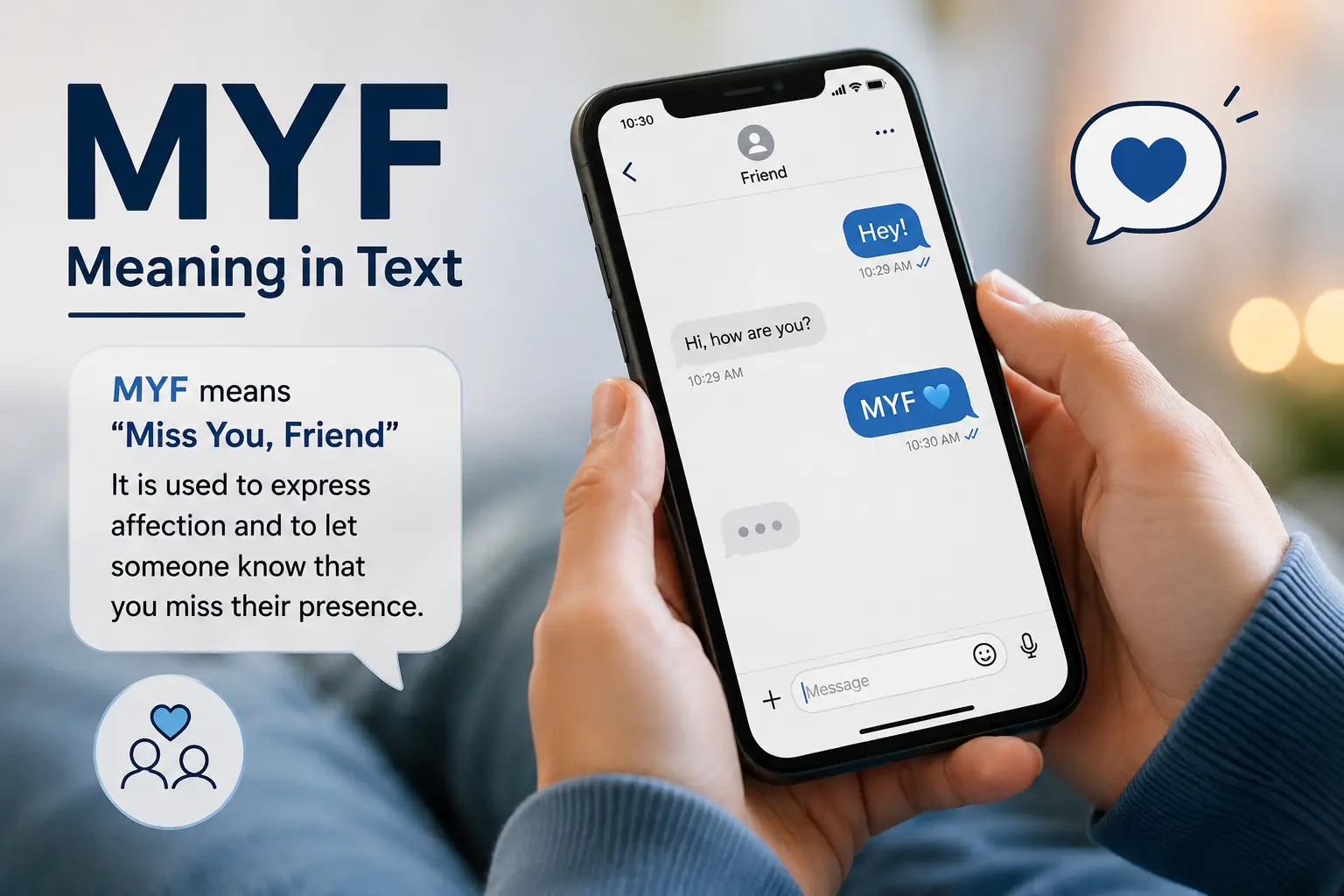
Texting is full of short letters that stand for longer phrases. If a friend just sent you “MYF” and you have no idea what it means, you are not alone.
So, what is the MYF meaning in text? MYF most often means “Miss Your Face,” a casual, friendly way of saying someone misses seeing you. But that is not its only meaning, and this guide will walk you through all of them.
This guide is for anyone who saw MYF in a text, comment, or DM and wants a clear, simple answer. You will learn what it usually means, other possible meanings, where it shows up, and how to use it the right way.
MYF usually means “Miss Your Face” in texting, used as a friendly or affectionate way to say you miss someone. It can also mean “My Fault,” used as a quick apology, or occasionally “Mind Your Business,” used to tell someone to back off. The correct meaning depends on the tone and context of the conversation.
Table of Contents
What Does MYF Mean in Text?
In most casual texting situations, MYF stands for “Miss Your Face.”
This is a friendly, sometimes slightly affectionate way of telling someone you miss seeing them, whether in person, in photos, or on video calls.
Example:
Friend 1: “Found this old photo of us from summer.” Friend 2: “Aww MYF! We need to hang out soon.”
In this example, MYF simply adds warmth to the message. It works well between close friends, family members, or partners.
Other Possible Meanings of MYF
Slang rarely has just one meaning, and MYF is no exception. Depending on the conversation, MYF can also stand for:
- “My Fault.” Used as a short, casual way to say sorry, similar to “my bad.”
- “Mind Your Business.” A blunt way of telling someone to stop asking or getting involved.
- “Miss You Friend.” A slightly more platonic version of “Miss Your Face,” often used between friends rather than romantic partners.
- “Miss You Forever.” A more dramatic or affectionate variation, sometimes used in emotional or sentimental messages.
Because there is no single official definition, tone and context matter more than the letters themselves.
| Meaning | Typical Tone | Common Use Case |
| Miss Your Face | Friendly or affectionate | Reconnecting with someone |
| My Fault | Casual apology | Quick, informal “sorry” |
| Mind Your Business | Blunt or defensive | Telling someone to back off |
| Miss You Friend | Platonic and warm | Between close friends |
Where You Usually See MYF
MYF tends to show up most in casual, fast-paced digital spaces rather than formal writing.
WhatsApp and Instagram
In direct messages or comments, MYF often appears under old photos or nostalgic posts, usually meaning “Miss Your Face.”
Read More: WallPostMedia Review: What This Multi-Niche Blog Actually Publishes
Snapchat and TikTok Comments
On these platforms, MYF is often used quickly and casually, sometimes paired with emojis to soften or clarify the tone.
Discord and Gaming Chats
In gaming or group chat spaces, MYF can appear as a quick, blunt reply, more often leaning toward “Mind Your Business” during a joking exchange.
Real Conversation Examples
Example 1: Friendly Chat
Person A: “Miss hanging out with you!” Person B: “MYF too, let’s plan something this weekend.”
Here, MYF clearly means “Miss Your Face,” used in a warm, friendly way.
Example 2: Gaming Chat
Player A: “Why’d you pick that character again?” Player B: “MYF, I know what I’m doing lol.”
In this case, MYF leans toward “Mind Your Business,” used playfully rather than seriously.
Example 3: Social Media Comment
Comment: “This throwback made my whole day. MYF.”
Here, MYF again points to “Miss Your Face,” a common way to react to nostalgic or sentimental posts.
MYF Compared to Similar Slang
MYF is often confused with other texting abbreviations. Here is a simple comparison:
- MYF vs. BRB: BRB means “be right back,” referring to a short pause, while MYF is emotional or reactive, not about timing.
- MYF vs. IMY: IMY means “I miss you” directly, while MYF is a more casual, indirect version often tied to a photo or memory.
- MYF vs. NVM: NVM means “never mind,” while MYF (in its “mind your business” sense) is more direct and can sound blunt or defensive.
Read More: Snowball Kiss: Meaning, Trend, Safety & Real Facts
When It Makes Sense to Use MYF
MYF fits naturally in:
- Casual chats with friends or family
- Comments under nostalgic or throwback photos
- Light, friendly apologies among people who know each other well
Example:
Text: “Sorry I forgot to text back yesterday, MYF!”
Here, MYF works as a quick, low-stakes apology between people who are already comfortable with each other.
When You Should Avoid Using MYF
MYF is not suited for every conversation. Avoid using it in:
- Professional emails or workplace messages
- Formal conversations with people you do not know well
- Serious situations that need a clear, direct apology or explanation
Because MYF has multiple possible meanings, using it in an unclear or formal setting can easily cause confusion.
Is MYF Rude or Offensive?
By itself, MYF is not considered offensive. Its tone depends heavily on which meaning is being used and the relationship between the people texting.
- As “Miss Your Face,” it is warm and friendly.
- As “My Fault,” it is casual but respectful.
- As “Mind Your Business,” it can sound blunt, though it is often used jokingly between friends rather than as a genuine insult.
As with most texting slang, tone can be hard to read without emojis or context, so it is worth being cautious with people you do not know well.
Common Mistakes People Make With MYF
- Assuming there is only one meaning. Context always matters more than the letters alone.
- Using it in formal settings. MYF is casual slang and does not fit professional communication.
- Ignoring tone cues. Without emojis or a friendly follow-up, “Mind Your Business” meanings can come across harsher than intended.
- Overusing it with new acquaintances. MYF works best with people who already know your communication style.
Similar Abbreviations Worth Knowing
Since slang terms often appear together, a few related abbreviations are worth knowing:
- IMY – I miss you
- MYB – My bad
- NVM – Never mind
- HMU – Hit me up
Learning a few related terms makes it easier to follow fast-paced group chats and comment sections.
Frequently Asked Questions
What is MYF meaning in text in simple terms? MYF most commonly means “Miss Your Face,” a casual way of saying you miss seeing someone.
Does MYF always mean “Miss Your Face”? Not always. It can also mean “My Fault,” “Mind Your Business,” or “Miss You Friend,” depending on context.
Is MYF used the same way on every platform? Mostly yes, though tone can shift slightly. On social media, it often leans emotional, while in gaming chats it can lean more toward “Mind Your Business.”
Is MYF considered rude? Not inherently. It depends on which meaning is intended and the relationship between the people texting.
Can I use MYF with someone I just met? It is safer to avoid it with new acquaintances, since the multiple meanings can easily cause confusion.
How do I know which meaning of MYF is being used? Look at the surrounding conversation and tone. A photo or nostalgic message usually points to “Miss Your Face,” while a defensive tone points to “Mind Your Business.”
Is MYF still commonly used in 2026? It remains a recognizable, though not extremely common, piece of casual texting slang, especially among younger social media users.
Should I reply if someone sends me MYF? A simple, friendly reply matching the tone, such as “Aww, miss you too!” usually works well if the message feels warm and casual.
Final Thoughts
Understanding the MYF meaning in text comes down to reading the tone and context of the conversation. Most often, it is a warm, casual way to say you miss someone, though it can also work as a quick apology or a blunt way to set a boundary.
Next time MYF pops up in your messages, you will know exactly how to read it, and how to reply with confidence.